Submitting Music to A&R, College Radio, and Playlists: A 2026 Artist Guide
A working artist’s guide to paying for a real evaluation, a real delivery into the right inbox, and an honest listen — never a guaranteed add, deal, or spin.
Video credit
The inboxes of independent artists and managers are full of offers that sound like career infrastructure: guaranteed playlist adds, locked-in stream counts, “editorial placement” for a flat fee. In 2026, those promises are not merely unwise. On Spotify, they violate the terms of use and can put a catalog at risk.
Legitimate pitching still has a role. A finished song can be put in front of a human curator, a radio programmer, or an A&R executive, and that person can be accountable for a listen. What cannot honestly be sold is the outcome of that listen — a placement, a deal, radio play, playlister plays, streams, or a signing.
Avenue AR Pro is built around that line. It guarantees the evaluations (Hit Radar and Demo Doctor, with insight from the internal team), a place on The Hit List for qualifying tracks that score 70% or higher, and delivery of submissions directly into the inboxes of the listed contacts. It does not guarantee placement, deals, radio play, playlister plays, streams, signings, or any outcome whatsoever. And it is not involved in any deals or contracts made between the artist and any of those executives — everything is completely up to the artist.
This guide uses official platform rules to map three legitimate lanes — playlist curators, radio programmers, and label A&R plus pre-pitch evaluation — and to show how Avenue AR Pro works inside them.
What Spotify actually forbids
Spotify’s artist education pages are direct. An artificial stream is any stream that does not reflect genuine listener intent, including bot or scripted playback. Services that advertise streams, or guaranteed Spotify playlist placement, in exchange for money violate Spotify’s Terms and Conditions of Use.
When Spotify detects artificial streaming, those plays do not earn royalties, do not count toward public stream totals or charts, and do not help recommendations. A song can be pulled from playlists. The artist’s distributor may warn, penalize, suspend, or remove the music. In egregious cases, Spotify may remove the track altogether.
The company is also skeptical of services that charge only to be “considered” for user playlists, even without a guaranteed add, and tells artists to walk away from anything that sounds too good to be true.
That official line is the first filter for every invoice. If a sales page promises a fixed number of streams, followers, or playlist adds for a fee, it is a red flag. A legitimate service sells a listen, a review, an evaluation, or delivery into a real inbox — and leaves the add, the spin, and the signing to the person on the other end.

Photo credit

The three legitimate lanes
Most serious independent campaigns use one of three lanes, or a mix of them. They are not interchangeable. Playlist curators hear records for user playlists. Radio programmers decide what gets aired. A&R executives look for records they can sign or champion — and, in some cases, a pre-pitch evaluation can tell you whether the record is ready before you spend the outreach.
| Lane | What you pay for | What’s never guaranteed | Best fit | Red flags |
|---|---|---|---|---|
| Playlist curators | A structured path to people who run user playlists, so a finished record can be heard by a human curator. On Avenue AR Pro, Discover & Submit delivers the track directly into the inboxes of listed playlist contacts. | A playlist add, a promised stream total, playlister plays, official editorial placement on Spotify, or any other outcome. | Artists seeking user-playlist consideration from named contacts, not a purchased add. | Guaranteed adds or stream counts; unnamed “networks”; claims of access to a streaming service’s official editorial team; any offer that sells the outcome of the listen. |
| Radio programmers | A documented path to programmers, music directors, or station DJs. On Avenue AR Pro, tracks sent to college and indie stations are pre-checked for FCC clearance and copyright (radio-safe audio), and a 2-credit Call Station unlock is optional. Stations can accept a submission knowing it has already been cleared, instead of an artist sending a track in raw and going through the back-and-forth of getting clearance themselves. | Airplay, rotation, a station add, or radio play of any kind. | Artists whose records are formatted for radio and who want programmers—not only playlist curators—to hear the work. | Guaranteed spins or “paid rotation”; vague station lists; no statement that airplay is the station’s decision. |
| Label A&R & pre-pitch evaluation | A route to A&R executives and, optionally, a pre-pitch evaluation with insight from the internal team. On Avenue AR Pro, Hit Radar costs 10 credits (2 credits to re-screen a revision) and Demo Doctor costs 5 credits. Executive outreach includes Direct to Inbox or 1-on-1 Video Meetings, with a 7–25 business day feedback window, plus tracking of listen time, a rating out of 10, saves, and shares. Qualifying tracks that score 70% or higher enter The Hit List. | A signing, a meeting outcome, a deal or contract, airplay, a playlist add, or any other result. The Hit List is decision-support, not a purchased placement. | Artists and managers who want label and radio decision-makers to hear a record, and who may want an honest readiness check first. | Pay-for-sign offers or “guaranteed A&R placement”; treating an evaluation score as purchased promotion; any service that involves itself in the artist’s deals or contracts. |
Playlist curators
- What you pay for
- A structured path to people who run user playlists, so a finished record can be heard by a human curator. On Avenue AR Pro, Discover & Submit delivers the track directly into the inboxes of listed playlist contacts.
- What’s never guaranteed
- A playlist add, a promised stream total, playlister plays, official editorial placement on Spotify, or any other outcome.
- Best fit
- Artists seeking user-playlist consideration from named contacts, not a purchased add.
- Red flags
- Guaranteed adds or stream counts; unnamed “networks”; claims of access to a streaming service’s official editorial team; any offer that sells the outcome of the listen.
Radio programmers
- What you pay for
- A documented path to programmers, music directors, or station DJs. On Avenue AR Pro, tracks sent to college and indie stations are pre-checked for FCC clearance and copyright (radio-safe audio), and a 2-credit Call Station unlock is optional. Stations can accept a submission knowing it has already been cleared, instead of an artist sending a track in raw and going through the back-and-forth of getting clearance themselves.
- What’s never guaranteed
- Airplay, rotation, a station add, or radio play of any kind.
- Best fit
- Artists whose records are formatted for radio and who want programmers—not only playlist curators—to hear the work.
- Red flags
- Guaranteed spins or “paid rotation”; vague station lists; no statement that airplay is the station’s decision.
Label A&R & pre-pitch evaluation
- What you pay for
- A route to A&R executives and, optionally, a pre-pitch evaluation with insight from the internal team. On Avenue AR Pro, Hit Radar costs 10 credits (2 credits to re-screen a revision) and Demo Doctor costs 5 credits. Executive outreach includes Direct to Inbox or 1-on-1 Video Meetings, with a 7–25 business day feedback window, plus tracking of listen time, a rating out of 10, saves, and shares. Qualifying tracks that score 70% or higher enter The Hit List.
- What’s never guaranteed
- A signing, a meeting outcome, a deal or contract, airplay, a playlist add, or any other result. The Hit List is decision-support, not a purchased placement.
- Best fit
- Artists and managers who want label and radio decision-makers to hear a record, and who may want an honest readiness check first.
- Red flags
- Pay-for-sign offers or “guaranteed A&R placement”; treating an evaluation score as purchased promotion; any service that involves itself in the artist’s deals or contracts.
Playlist curators
A playlist curator is choosing music for a user playlist, not promising official editorial placement on Spotify and not selling a stream count. What you can legitimately pay for is a structured path to a named contact and an honest listen. What you cannot legitimately buy is the add.
On Avenue AR Pro, Discover & Submit is the outreach lane for playlist curators as well as for executives and radio. Submissions are delivered directly into the inboxes of the listed contacts. That delivery is guaranteed. A playlister play, a playlist add, or a stream total is not.
Radio programmers
Radio is a different buyer. A music director or programmer is choosing music for a station’s sound and audience, not running a user playlist for algorithmic discovery. Paying for a guaranteed spin on a commercial station should stop a campaign immediately. Paying for a documented path to be heard — while knowing that airplay is still the station’s decision — is a different product.
Avenue AR Pro treats radio as a core discovery path. Its public homepage currently lists 349 radio stations, and a weekly Hit List newsletter goes to radio station DJs on the platform. Artists can submit to college and indie stations, and may optionally spend 2 credits on a Call Station unlock.
Every track a station receives through the platform is pre-checked for FCC clearance and copyright — radio-safe, cleared audio. Radio stations gladly accept that kind of submission because they know the track has already been cleared, versus an artist sending a track in raw and going through the back-and-forth of getting clearance themselves. That does not guarantee a spin. It removes a compliance hurdle, so a programmer who hears and likes a song is more willing to accept and play it.
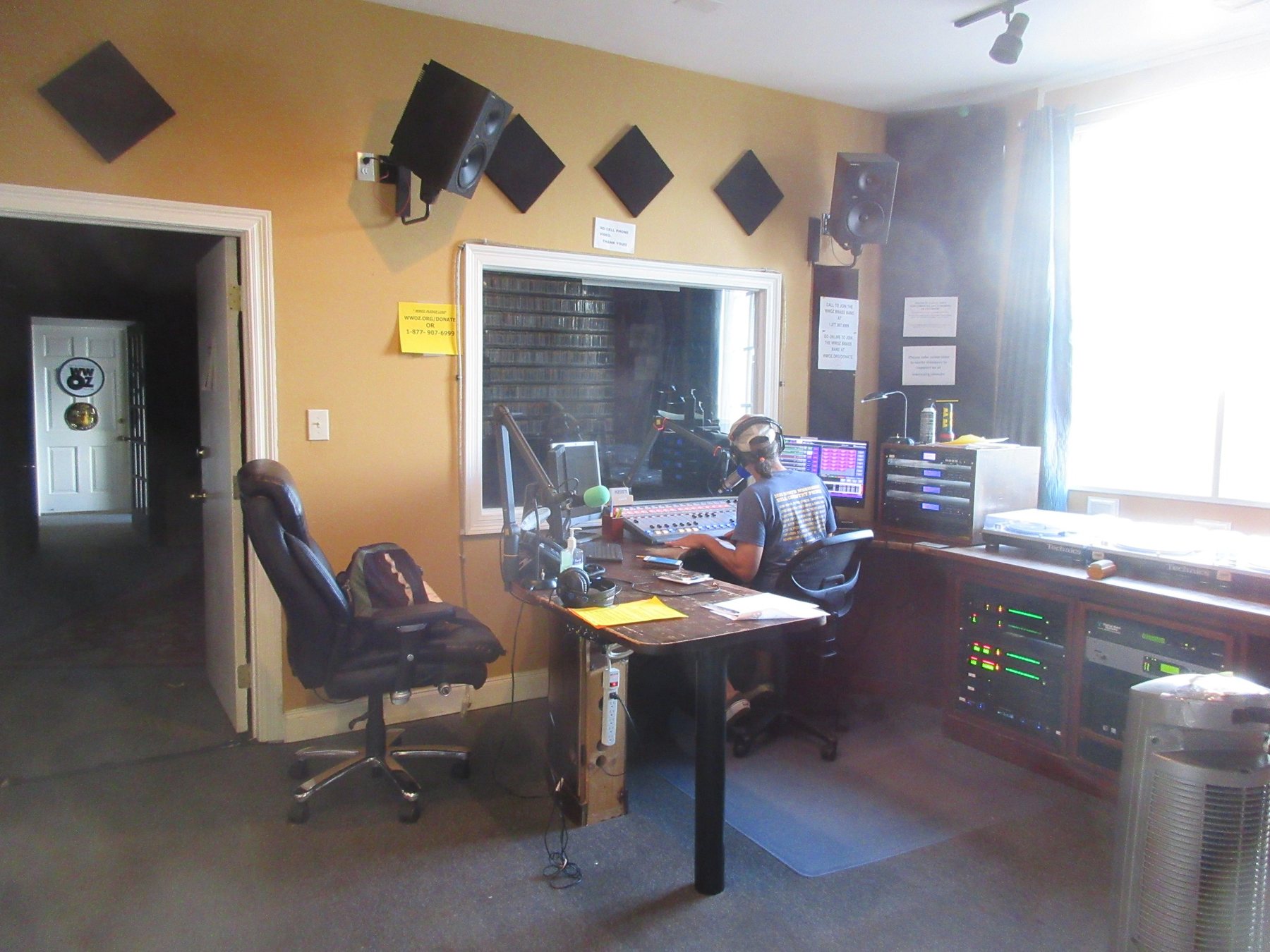
Photo credit

Label A&R and pre-pitch evaluation
Getting a song in front of a playlist curator and getting it in front of a record-label A&R executive are not the same job. Curators often review a high volume of submissions. A&R executives are paid to find records they can sign or champion. A platform that blurs those roles without saying so is harder to evaluate.
Avenue AR Pro is a useful public example of an A&R- and radio-focused platform, built for independent musicians, managers, and teams to pitch tracks to label A&R executives, radio programmers, and playlist curators. As of 27 November 2026, its public homepage lists 23 executives, 349 radio stations, and 11K+ playlists.
The guarantees stay the same in this lane. Evaluations — Hit Radar and Demo Doctor, with insight from the internal team — are guaranteed, as is The Hit List for qualifying tracks that score 70% or higher, and delivery of submissions directly into the inboxes of the listed contacts. Placement, deals, radio play, playlister plays, streams, signings, or any other outcome are not. Avenue AR Pro is not involved in any deals or contracts made between the artist and any of these executives. Everything is completely up to the artist.
23
Executives on the public homepage
349
Radio stations, with a weekly Hit List newsletter for station DJs
11K+
Playlists listed on the public homepage
Discover & Submit
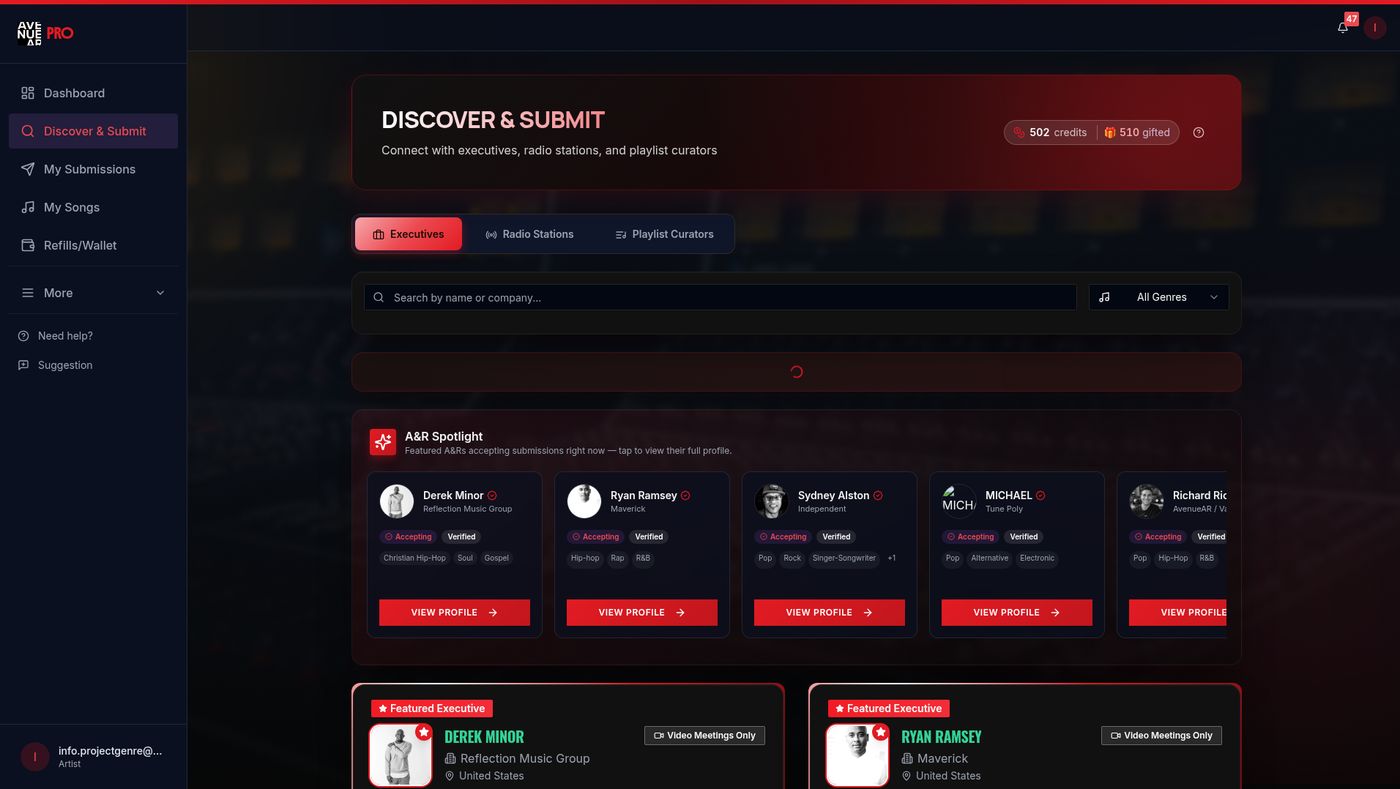
On the artist side of the platform, Discover & Submit is the outreach lane. Artists can send a track to executives via Direct to Inbox or 1-on-1 Video Meetings, with a 7–25 business day feedback window; to college and indie radio stations, with the optional 2-credit Call Station unlock; and to playlist curators. Submissions are delivered directly into the inboxes of the listed contacts. Tracking shows exact listen time, an executive rating out of 10, and whether the recipient saved or shared the song. Those metrics document a listen. They do not promise a signing, a meeting outcome, a spin, or a playlist add.
Tracks sent to college and indie stations are pre-checked for FCC clearance and copyright. Stations gladly accept a cleared submission because they know the work has already been checked — versus an artist sending a track in raw and going through the back-and-forth of getting clearance themselves.
Hit Radar
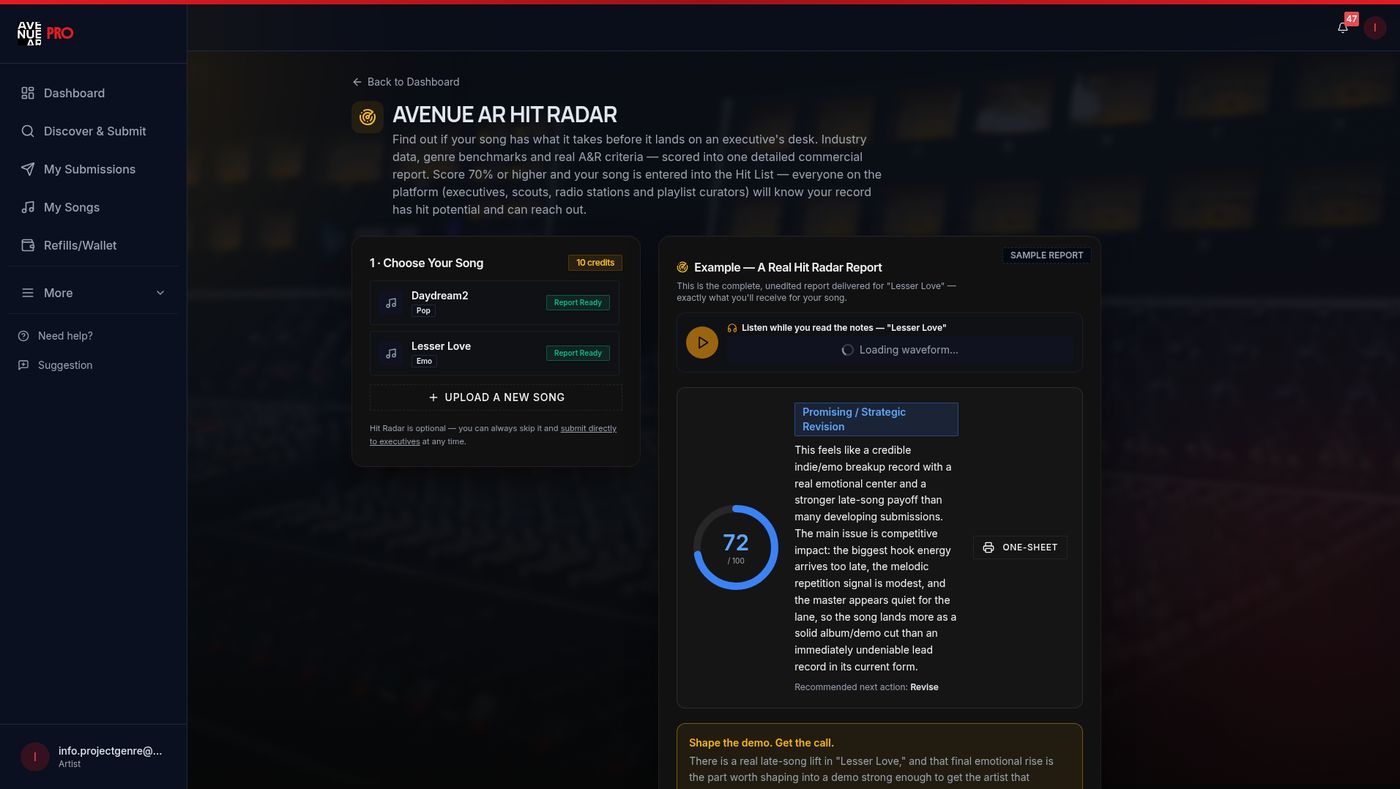
Hit Radar costs 10 credits, or 2 credits to re-screen a revised version. It is a guaranteed evaluation, with insight from the internal team. It returns seven A&R sub-scores and a Genre Benchmark table covering BPM, length, intro, first energy peak, and approximate LUFS against hit norms. A score of 70% or higher enters the platform’s Hit List, described as merit-based rather than a paid campaign placement. The list is visible to executives, and a weekly newsletter goes to radio station DJs. The tool is decision-support: it does not guarantee placement.
Demo Doctor
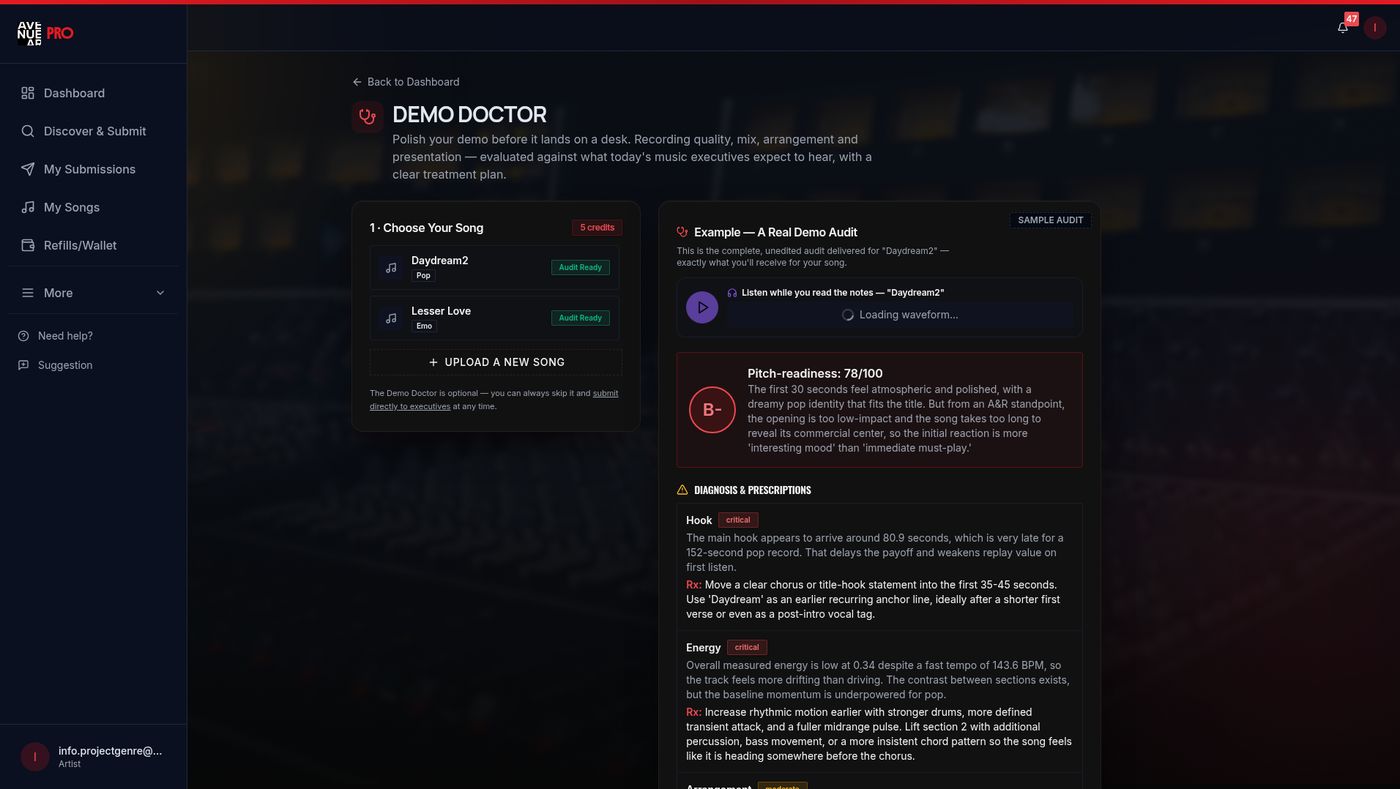
Demo Doctor costs 5 credits. It is a guaranteed first-thirty-seconds audit of mix, arrangement, and presentation, with insight from the internal team, a letter grade, a Pitch-Readiness score, a waveform player, and a Diagnosis and Rx: Prescriptions across seven categories: Hook, Energy, Arrangement, Songwriting, Production, Mix, and Low End. It is quality control, not a purchased outcome, and it is not a substitute for a finished record.
A short checklist before you pay
What, exactly, are you buying?
You’re buying evaluations, and delivery of your song to college radio stations, playlists, and curators. Avenue AR Pro doesn’t guarantee you get played, doesn’t guarantee a stream count, doesn’t guarantee a follower count, doesn’t guarantee radio play, and doesn’t guarantee a deal, money, or getting signed — that strictly depends on your talent, your music, and your ability to wow.
What is actually guaranteed?
Avenue AR Pro’s public position is specific: the evaluations (Hit Radar and Demo Doctor, with insight from the internal team), The Hit List for qualifying tracks that score 70% or higher, and delivery of submissions directly into the inboxes of the listed contacts. Nothing else — not a reply, a play, a deal, or a signing.
Who hears the song?
Prefer named curators, stations, or roles you can inspect before you spend. Be wary of an anonymous “network,” and of any claim of access to a streaming service’s official editorial team unless the service documents it.
Is the record cleared for the room it is entering?
For radio, this matters. Avenue AR Pro includes an FCC and copyright check through AudD, which radio stations gladly accept because they know the submission has already been cleared — versus an artist sending a track in raw and going through the back-and-forth of getting clearance themselves. That does not guarantee a spin. It removes a compliance hurdle.
Is anything else guaranteed?
No. Avenue AR Pro doesn’t guarantee anything besides the delivery of your song to wherever you choose to have it go.
How should you take the tools?
The tools provided are just suggestions, based on Avenue AR Pro’s internal A&R and proprietary algorithms. They can help you hear a record more clearly before you send it, but they are not a verdict — and they are not a substitute for a finished record you believe in.
The through line is simple. In 2026, the white-hat way to buy help is to pay for a real evaluation, delivery into the right inbox, and honest feedback — and to refuse anyone who offers to sell you the chart position, the spin, or the deal that only the other side can decide, and that only real listeners can create.
Sources
All facts in this article were verified from the live public pages below on November 27, 2026. Nothing in this article is drawn from Google Search Console or from competitors’ private data.
- 1. Spotify for Artists, “Artificial Streaming.”artists.spotify.com
- 2. Spotify Support, “Artificial streaming and paid 3rd-party services that guarantee streams.”support.spotify.com
- 3. Spotify, Terms and Conditions of Use.spotify.com
- 4. Spotify, User Guidelines.spotify.com
- 5. Avenue AR Pro, public homepage and platform (product positioning; homepage counts of 23 executives, 349 radio stations, and 11K+ playlists; Discover & Submit; Hit Radar; Demo Doctor; radio FCC and copyright pre-check). Retrieved November 27, 2026.avenuear.app
- 6. Wikimedia Commons, “SSL AWS 900+ at Performance Studio.jpg,” photo by Liz Bustamante, CC BY 2.0.commons.wikimedia.org
- 7. Wikimedia Commons, “Radio WWOZ Studios New Orleans June 2021 - Control room.jpg,” photo by Infrogmation of New Orleans, CC BY 2.0.commons.wikimedia.org
- 8. Creative Commons, Attribution 2.0 Generic (CC BY 2.0).creativecommons.org
- 9. AudD, music recognition (used by Avenue AR Pro for FCC compliance and copyright ownership checks, as shown on the live platform: “Approved by AudD,” “Verified for FCC compliance and copyright ownership via AudD audio fingerprinting”). Retrieved November 27, 2026.audd.io